
What Size Air Conditioner Do I Need?
Home air conditioning systems are available in three main categories: traditional split-system air conditioners, packaged air conditioners and ductless systems. Each of these operate by the same basic process to lower the temperature and dehumidify the air in our homes. They all require an evaporator coil, a condenser coil, a compressor and refrigerant to essentially pull heat and humidity out of the home while returning cooler air to your living spaces. Regardless of which type of system works best for your home, correctly sizing it will provide the best results in comfort, performance and energy-efficiency. For most people, determining the proper size will be best handled by a professional HVAC contractor who can recommend the best air conditioner for your home.
An HVAC contractor will understand the variables involved and be able to perform the cooling load calculations necessary for proper air conditioner sizing. However, understanding some of the principles behind cooling system sizing and the reasons why it’s so important will be helpful when considering a new system for your home. For example, when it comes to the size of your home air conditioner, size matters and bigger is not necessarily better. Equipping your space with a larger system with too many tons of cooling capacity not only uses more energy than necessary which will raise your electric bill, but an oversized air conditioner could also cycle on and off too quickly without adequately removing humidity from the air, leaving you feeling cool but damp. Conversely, an air conditioner that’s too small for your space will work overtime trying to cool the space, consuming more energy without fully doing the job. A properly sized air conditioner matched to the unique needs of your home will not only keep you comfortable, it can also help you save on your energy bills. Because there is no simple answer to the question, “What size air conditioner do I need?” and because it is so important to your comfort and energy consumption, we always recommend getting a professional assessment of your property. Ariana Heating can account for all of the factors involved and determine the optimal AC unit size for your home.
How Are Air Conditioners Rated?
Air conditioners are typically rated two ways: cooling capacity and energy efficiency. When you ask the question, “what size AC unit do I need?” you’ll be interested in cooling capacity as measured in BTU or tons. To compare energy efficiency air conditioner systems, you’ll usually look for the SEER2, or Seasonal Energy Efficiency Ratio 2, which is kind of like the air conditioner version of miles per gallon for a car.
Cooling Capacity
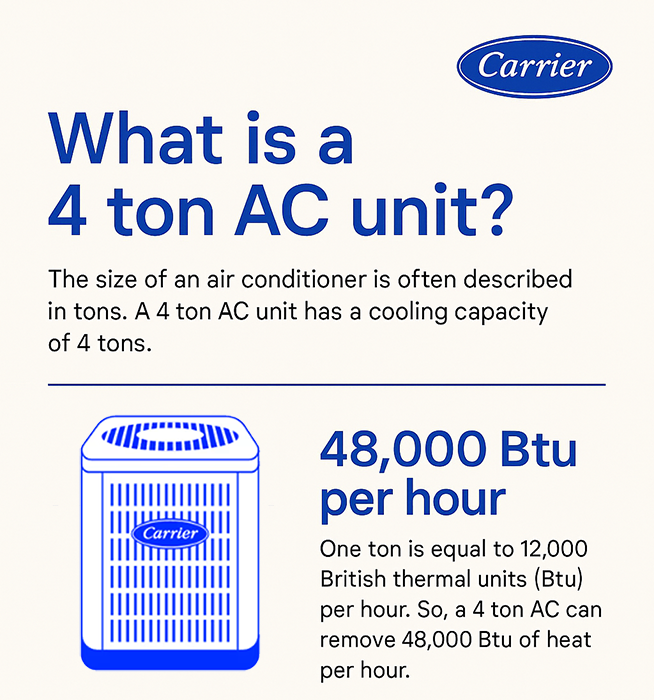
Cooling capacity offers a concrete measure to help determine whether a particular air conditioner is an appropriate fit to cool your home. An air conditioner’s cooling capacity is expressed in BTUh (British Thermal Units per Hour) or tons (often referred to as “tonnage”). Both offer a measurement of an air conditioner’s cooling ability over an hour’s time. One ton of cooling capacity is equal to 12,000 BTUh. Residential air conditioners usually range from 1.5 to 5 tons (or, 18,000 – 60,000 BTUh). Anything with larger cooling capacity would be considered light commercial. Tonnage ratings are typically expressed in increments of .5 tons, so residential air conditioners are usually rated as 1.5, 2, 2.5, 3, 3.5, 4, 4.5 or 5 ton units. It should be noted that there is a distinct difference between BTU and BTUh. BTU, or British Thermal Units, is actually a measurement for the amount of heat needed to raise one pound of water by one degree Fahrenheit. BTUh represents a measure of how much heat in BTUs an air conditioner can remove from your home over an hour’s time.
SEER2 Rating
Air conditioners use SEER2 ratings to indicate energy efficiency. SEER2 stands for Seasonal Energy Efficiency Ratio 2 and is used to help consumers make informed choices about the systems they choose for their homes. By definition, SEER2 ratings are the total amount of cooling provided during the entire cooling season divided by the total electrical input during the cooling season. Much like MPG (miles per gallon) for a car, the higher the SEER2 rating, the more energy efficient the system. Bear in mind, two AC units with the same cooling capacity could have very different SEER2 ratings. For example, when looking at two different 3-ton air conditioner models, one might be rated at 13 SEER2, and the other might be a much more efficient 19 SEER2 unit.
What Size Air Conditioner Do I Need For My Space?

While there are formulas available to help you estimate the right sized AC unit for your home, the easiest and most accurate method is to rely on a professional HVAC contractor. They’ll be able to precisely measure your home, weigh each of the factors that go into the equation, and provide an accurate assessment of the right-sized equipment for your home.
Air Conditioner Size Calculation
To determine the best fit for an HVAC system for your home, Ariana Heating will perform what is called a “load calculation”. This will tell you the amount of cooling capacity required to maintain a consistent temperature within the home. HVAC contractor will compile information like square footage, window and door area, insulation quality and climate to figure out just how much heating capacity and cooling capacity is required by your system.
Additional Variables For Air Conditioner Sizing
Choosing the right size matters and there are many variables that must be taken into consideration when determining the correct size air conditioner for your home. Factors that your HVAC contractor will take into consideration include:
Total square footage of interior space to push the cool air into
Approximate amount of direct sun exposure
Head count of typical number of people at home
Types and numbers of appliances or equipment that generate heat
Weather conditions/climate
Quality and total number of exterior windows
Quality and R-value of insulation
Type of construction, such as brick exterior or vinyl siding
Interior ductwork/airflow assessment
Features that contribute to heating & cooling loss or gain, such as fireplaces, ceiling height or skylights
AC Unit Calculator
While many AC unit calculators exist online, it’s recommended that air conditioner size calculations are conducted by a trained HVAC professional. HVAC technicians have specialized software programs and hands-on experience that can perform a manual load calculation. Contact Ariana Heating for more information!
